DermaHarmony
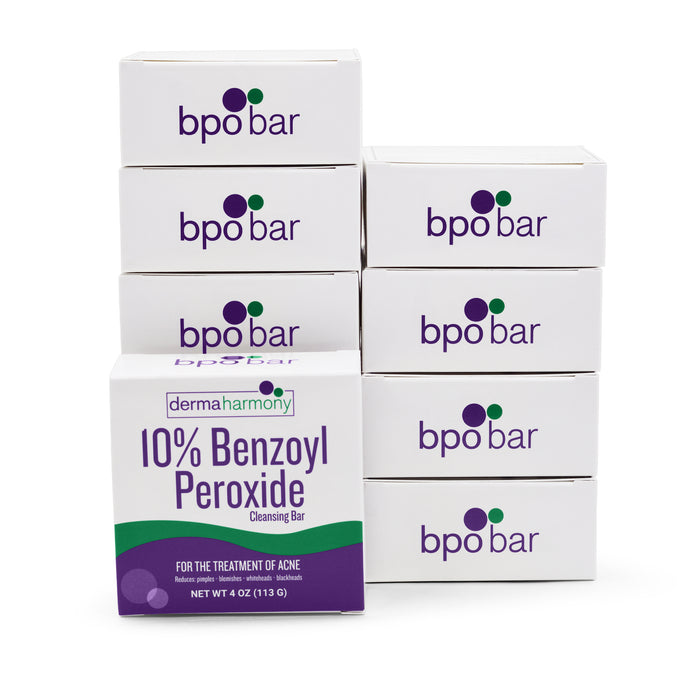
10% Benzoyl Peroxide Cleansing Bar (non-soap) - Unscented
10% Benzoyl Peroxide Cleansing Bar (non-soap) - Unscented
Couldn't load pickup availability
ABOUT THIS PRODUCT
Maximum-strength benzoyl peroxide. Without the bottle.
If you're treating acne with benzoyl peroxide, you've almost certainly purchased BPO it in a plastic bottle or tube — a foaming wash, a creamy cleanser, an ointment, a pump. That's simply how the category has evolved. Between roughly 1995 and 2010, benzoyl peroxide bars nearly disappeared from American shelves as liquid washes took over the acne aisle, and a generation of shoppers grew up never seeing the bar option at all.
DermaHarmony's 10% Benzoyl Peroxide Cleansing Bar delivers benzoyl peroxide at 10% — the highest concentration permitted in an over-the-counter acne treatment — in a rinse-off format that does the same job the bottled BPO wash does. Lather, wash for a minute or two, rinse. Same active. Same mechanism against blackheads, whiteheads, and pimples. What you leave behind is the 'product water', the plastic, the pump, and the supporting cast of ingredients a liquid formula needs just to stay liquid.
Benzoyl peroxide is one of the active ingredients the FDA recognizes as generally recognized as safe and effective (GRASE) for acne under its OTC topical acne drug monograph, permitted from 2.5% up to 10%. It reduces acne-causing bacteria on the skin and helps clear the dead skin that blocks pores — the combination that makes it effective on inflammatory acne: the red, tender, pus-filled bumps known as papules, pustules, cysts, and nodules. If your breakouts are mainly surface blackheads and whiteheads, a salicylic acid or sulfur bar may serve you better. If you get red, angry pimples, benzoyl peroxide belongs in your rotation.
Prefer to start gentler? Clinical research suggests you don't necessarily need the maximum strength — see our 5% Benzoyl Peroxide Cleansing Bar, and the note further down this page.
Why a Bar instead of a Wash or Foam?
This is the honest case, and it isn't about the active ingredient — a well-made 10% BPO wash and a well-made 10% BPO bar both deliver benzoyl peroxide to your skin. It's about everything wrapped around the active.
A liquid wash is mostly water — and you use far more of it.
Water is the base ingredient in essentially every liquid cleanser and body wash on the market. Published formulation guides from cosmetic-ingredient suppliers put water at roughly 50–70% of a typical body wash by weight (Lubrizol formulation data), and the cosmetics certification body NATRUE notes that rinse-off products such as shower gels and cleansers can run up to 95% water, while bar soaps may contain only traces or none at all.
You also use dramatically more product per wash. A peer-reviewed life-cycle assessment by ETH Zurich researchers measured this directly: a single hand-wash consumed 2.3 grams of liquid soap versus 0.35 grams of bar soap — roughly 6.6 times more product by weight to accomplish the same wash (Koehler & Wildbolz, Environmental Science & Technology, 2009). That is why one 4 oz bar goes a long, long way.
A liquid formula needs ingredients a bar doesn't.
Suspending benzoyl peroxide in water and keeping it stable, pourable, and shelf-stable requires a supporting cast: emulsifiers, thickeners, chelators, preservatives, solubilizers. Some 10% BPO liquid products on the market build their vehicle from petrolatum and fatty alcohols and add fragrance, menthol, BHT, benzyl alcohol, and ethoxylated ingredients on top of the active. Others are formulated much more cleanly than that — we're not going to pretend every liquid wash is a problem, because it isn't. But the pattern holds: a liquid has more jobs to do to deliver the active, and every one of those jobs is another ingredient on the label.
Our bar has ten ingredients total, including the active. It doesn't need a preservative system, because it isn't a water-based product sitting in a warm bottle. It doesn't need fragrance to mask a base note, because it's unscented. And there's no colorant at all — no dye, no iron oxides, nothing added to make it look like anything.
A bar doesn't come in a bottle
We'd rather show you the numbers than call ourselves green. Bottom line: Bars are a lower-impact way to buy Benzoyl Peroxide.
You stop shipping water. A 4 oz bar is 4 oz of product. A bottled wash is largely water that has to be trucked across the country along with the active ingredient. There's an obvious greenhouse gas impact here.
You use less product to get the same wash. The ETH Zurich life-cycle assessment cited above found liquid soap's cradle-to-gate fossil energy demand runs 1.5 to 4.6 times higher than bar soap's, and concluded that hand-washing with bar soap was preferable to liquid soap across the environmental indicators the study measured — driven largely by that 6.6× difference in product used per wash (Koehler & Wildbolz, 2009). Worth noting for honesty's sake: the same study found bar soap carries a larger land-use impact, because bar formats lean on vegetable-oilderived ingredients. It's a real trade-off, and we'd rather you hear it from us.
The packaging math is not close. Our bar ships in a printed paperboard carton. A liquid wash ships in a plastic bottle, usually with a pump. Using a single year of EPA reporting so the comparison is apples to apples: paper and paperboard packaging was recycled at about 68% in the United States — the highest rate of any material in municipal solid waste — while plastics were recycled at about 8.5% (U.S. EPA; EPA containers and packaging data). Paperboard containers and packaging specifically came in at 80.9%.
And the pump is trash. Not a figure of speech — a literal one. Pump dispensers are multimaterial assemblies: a stainless-steel spring, a polypropylene dip tube, and a housing in a third plastic. Curbside programs don't accept them. The bottle may be recyclable; the pump has to come off and go in the garbage first, and most people don't know that.
We're not claiming perfection. Our bar is sealed in a polypropylene wrap inside the carton, and we'd rather tell you plainly that polypropylene is one of the harder plastics to actually recycle in the U.S. — accepted by some municipal programs and not others, so check locally rather than assuming. That wrap is there for a reason: benzoyl peroxide degrades on exposure to air, heat, and moisture, and the seal is what protects the potency you paid for. The carton ink is not petroleum-based, which makes the carton easier to recycle.
Why this matters more than it sounds like it should. Acne treatment is not a one-bottle problem. It's a daily product used for months or years, often over large areas like the back, chest, and shoulders. Multiply one person's routine across a few years and the format choice compounds. Consumer demand is already moving this direction — 81% of beauty shoppers say brands should actively reduce plastic packaging, and 47% say they'd pay more for sustainable packaging (CleanHub consumer survey) — but the acne aisle has been slow to offer the option. We think the bar should be the default way to buy a rinse-off acne treatment, not the curiosity.
About Strength: Do You Actually Need 10%?
We sell the maximum strength and we'll still tell you the research honestly. A landmark double blind clinical study compared 2.5%, 5%, and 10% benzoyl peroxide head to head and found them comparably effective at reducing inflammatory acne lesions, with the higher concentrations producing significantly more dryness, redness, and burning. In a rinse-off format like a bar — where contact time is measured in seconds, not hours — that finding matters even more.
So why offer 10%? Because some people have built tolerance, some are treating stubborn body acne over large areas, and some have been directed to 10% by their doctor. Choose 10% if that's you. If you're new to benzoyl peroxide, or you have dry, sensitive, or reactive skin, we'd genuinely rather sell you the 5% bar and have you still be using it in three months.
What Makes This Bar Different
- A true non-soap syndet formula. No sodium tallowate, no lye-based soap chemistry, no alkali soap salts raising the bar's pH. The cleansing system is built on coco glucoside, sodium isethionate, and sodium cocoyl isethionate — plant- and mineral-derived surfactants selected for mildness.
- Structured with fatty acids, not filler. Coconut fatty acid and stearic acid remain in the finished bar as unneutralized free fatty acids, giving it firmness and long wear. They're the same category of ingredient that contributes to the bar's mild cleansing action — not a separate starch-and-salt system added purely to bulk the bar out.
- Buffered with lactic acid. A naturally derived AHA that supports pH balance and light exfoliation with every wash.
- Ten ingredients. No preservatives, no fragrance, no colorants. This bar contains no iron oxides and no dye of any kind. It's left completely uncolored on purpose — which also means you can tell it apart at a glance from our 5% bar, which is tinted with real iron oxide minerals.
- No Ethylene/VA Copolymer. We don't use this plastic-derived film former in any DermaHarmony product.
- No cocamidopropyl betaine. A surfactant associated with contact-allergy and irritation concerns — left out entirely.
- No tallow, ever. Consistent with our commitment to avoid animal-derived ingredients.
- Made in the USA, by us. We own the formula, choose every ingredient and every source, and run production ourselves. The bar you bought from us years ago is the same bar you'll get today — on a supply chain that costs us more precisely because nothing changes without us.
- Family-owned in Maine for nearly 30 years, and wholly focused on cleansing problem skin.
One note on the bar category, for completeness: a small number of other brands sell 10% benzoyl peroxide bars, and their current formulations are a real improvement over what the category offered years ago. We're glad the format is coming back. Our formula has been built to our own soap-free syndet specification from the start, and we're confident in it — but the choice we most want you to consider isn't which bar. It's bar instead of bottle.
Who It's For
You'll likely get the most out of this bar if you:
- Currently use a 10% benzoyl peroxide liquid wash or cream cleanser and want the same treatment without the bottle, pump, or filler water
- Want to cut plastic out of a product you'll be using daily for months
- Have moderate to stubborn inflammatory acne — red, tender, pus-filled bumps — and have already tolerated benzoyl peroxide
- Treat acne on your back, chest, shoulders, or buttocks, where a bar covers a large area far more easily than a pump bottle
- Read ingredient labels and would rather have ten ingredients than twenty
- Are sensitive to fragrance and want an unscented, dye-free acne treatment
- Want a syndet (non-soap) bar because traditional soap leaves your skin tight and stripped
- Prefer to avoid plastic-derived film formers
- Have been directed by a doctor to use maximum-strength benzoyl peroxide
How Benzoyl Peroxide Compares to Our Other Acne Actives
Benzoyl Peroxide vs. Sulfur
Both treat acne, through different mechanisms. Sulfur works at pore level through a gentler drying and clearing action, is usually the better-tolerated choice for reactive skin, and won't bleach fabric. Benzoyl peroxide goes further against inflammatory, bacteria-driven acne, which is why it's the stronger choice for red, pus-filled breakouts rather than surface congestion. If dryness is your main worry and your acne is mostly non-inflammatory, our 10% Sulfur with Tea Tree Oil Bar Soap is worth trying first or in rotation.
Benzoyl Peroxide vs. Salicylic Acid
Salicylic acid is a beta hydroxy acid that works inside the pore, dissolving the buildup behind blackheads and whiteheads. It lacks benzoyl peroxide's antibacterial action, but it's typically gentler and better suited to long-term daily maintenance. A common routine: use this bar to bring an active flare-up under control, then move to a salicylic acid bar for ongoing pore maintenance. FDA guidance advises against layering multiple topical acne actives on the same area at the same time unless a doctor directs it — the combined drying effect can exceed either ingredient alone.
A Note on Dryness & Irritation
Benzoyl peroxide dries and peels skin as part of how it works, and at 10% it does so more than at 5%. How to manage it:
- Days 1–7: Once daily, ideally in the evening. Follow immediately with an oil-free, noncomedogenic moisturizer.
- Week 2 onward: If your skin is tolerating it well, you can increase frequency as directed below.
- If flaking, tightness, or redness appear: Scale back to every other day until your skin adjusts, then build back up.
- Never scrub. Nothing gritty, nothing abrasive.
- The non-negotiable step: Moisturize every single time. It's the biggest factor separating "manageable" from "I quit."
- New to benzoyl peroxide? A sensible way to start: use the bar on just one or two small affected areas for the first three days. If no irritation develops, move to the full directions below.
- Still too much? Step down to the 5% bar rather than stopping treatment altogether.
A Note on the First Few Weeks (It May Look Worse Before It Looks Better)
Worth saying plainly: many people find their skin looks somewhat worse — more redness, a few new small breakouts — during the first two to three weeks on benzoyl peroxide, before it starts looking better. That's benzoyl peroxide surfacing congestion that was already forming beneath the skin, not a sign the product is wrong for you. Dryness and peeling are typically at their worst in those first three weeks. Give it a full six weeks before judging results; full effects can take two to three months. If irritation becomes severe, or hasn't begun improving by week six, stop use and check in with a doctor
BAR SIZE
4 OZ (113 G) - 2.6" x 2.6" x 1" Square - Single Bar Per Box
PURPOSE
Acne medication
DIRECTIONS
For best results use daily. Work-up a lather using warm water and gently massage into problem areas. Cleansing solution should stay in contact with skin for at least 60-90 seconds. Then rinse thoroughly and pat dry. Use at least twice a week on affected areas in place of your regular soap or as directed by a doctor. If bothersome dryness or peeling occurs, reduce application to once a day or every other day. If desired, follow cleansing with the moisturizer of your choosing.
WARNINGS
For external use only. Do not use if you have very sensitive skin, are sensitive to benzoyl peroxide. When using this product, avoid unnecessary sun exposure and use a sunscreen, avoid contact with the eyes, lips, and mouth, avoid contact with hair and dyed fabrics, which may be bleached by this product, skin irritation and dryness is more likely to occur if you use another topical acne medication at the same time, skin irritation may occur, characterized by redness, burning, itching, peeling, or possibly swelling. Irritation may be reduced by using the product less frequently or in a lower concentration. Stop use and ask a doctor if irritation becomes severe. Keep out of reach children. If swallowed, get medical help or contact a Poison Control Center right away.
BPO will bleach stain clothing and towels - use caution. It leaves funky orange stains on nearly everything it touches. Wash your hands well with soap and water after each application. Rinse your face and body extremely well before toweling off to prevent staining of fabrics.
ACTIVE INGREDIENT
10% Benzoyl Peroxide
INACTIVE INGREDIENTS
Sodium Cocoyl Isethionate (SCI): Known as Baby Foam due to its exceptional mildness, SCI raw material is a surfactant that is comprised of a type of sulphonic acid called Isethionic Acid as well as the sodium salt ester from Coconut Oil.
Stearic Acid: A vegetable derived waxy substance used as a thickening agent in shampoo bars.
Coconut Fatty Acid: A surfactant, cleansing agent, emulsifier and a foam booster.
Sodium Isethionate: An organic salt isethionic acid that was discovered in 1833. It is used as an organosulfur compound. It lowers the pH while maintaining a high level of detergency and lather.
Water
Coco Glucoside: A natural, gentle, and environmentally-friendly cleansing agent and surfactant (a word that is the shortened version of the term “Surface Active Agent”) sourced from coconuts. Sufactants prompt oil and water to combine, thereby making it easier for oily residue found on the hair to attach to syndet (synthetic detergent) and water, leaving the hair cleansed of any grease without stripping away its natural oils.
Cetearyl Alcohol Ceteareth-20: Emulgade 1000 Ni by BASF - a vegetable based emulsifying wax.
Lactic Acid: An Alpha Hydroxy Acid or AHA used to gently exfoliate the skin, lighten dark spots, and improve the look of fine lines and wrinkles.
Other ingredient information:
The 5% bar contains natural iron oxides which gives the bar an orange appearance (so that customers that use both the 10% and the 5% can differentiate between the bars).
STORAGE
Store in a cool dry place between 59° - 86° F (15° - 30° C) away from direct heat and humidity (not on a hot, steamy shower shelf). A bathroom cabinet or dry soap dish out of direct sun is the ideal spot. Benzoyl peroxide denatures at room temperature - it will begin to break down once exposed to air, heat, and moisture. Use within 12 months of purchase. Unopened product is good for two years from date of manufacture if bars have been stored in a controlled environment.
OTHER INFORMATION
Stamped/embossed: "dermaharmony".
Sealed in recyclable polypropylene inside carton.
Carton ink is not petroleum-based which is better for recycling.
This product is an Over-The-Counter (OTC) Drug.
Made in the USA of U.S. and imported ingredients.
NDC Code: 71819-011-04
ASIN: B0925B6RLP
GS1 UPC: 860004825838